Shop / High School (grades 9–12)

Rocket Flight Computer & Telemetry Lab

Available Grades 9–12 Aerospace Computing & data

Build a barometric + IMU flight logger for a model rocket, predict apogee from thrust and drag, then compare the prediction with the logged flight.

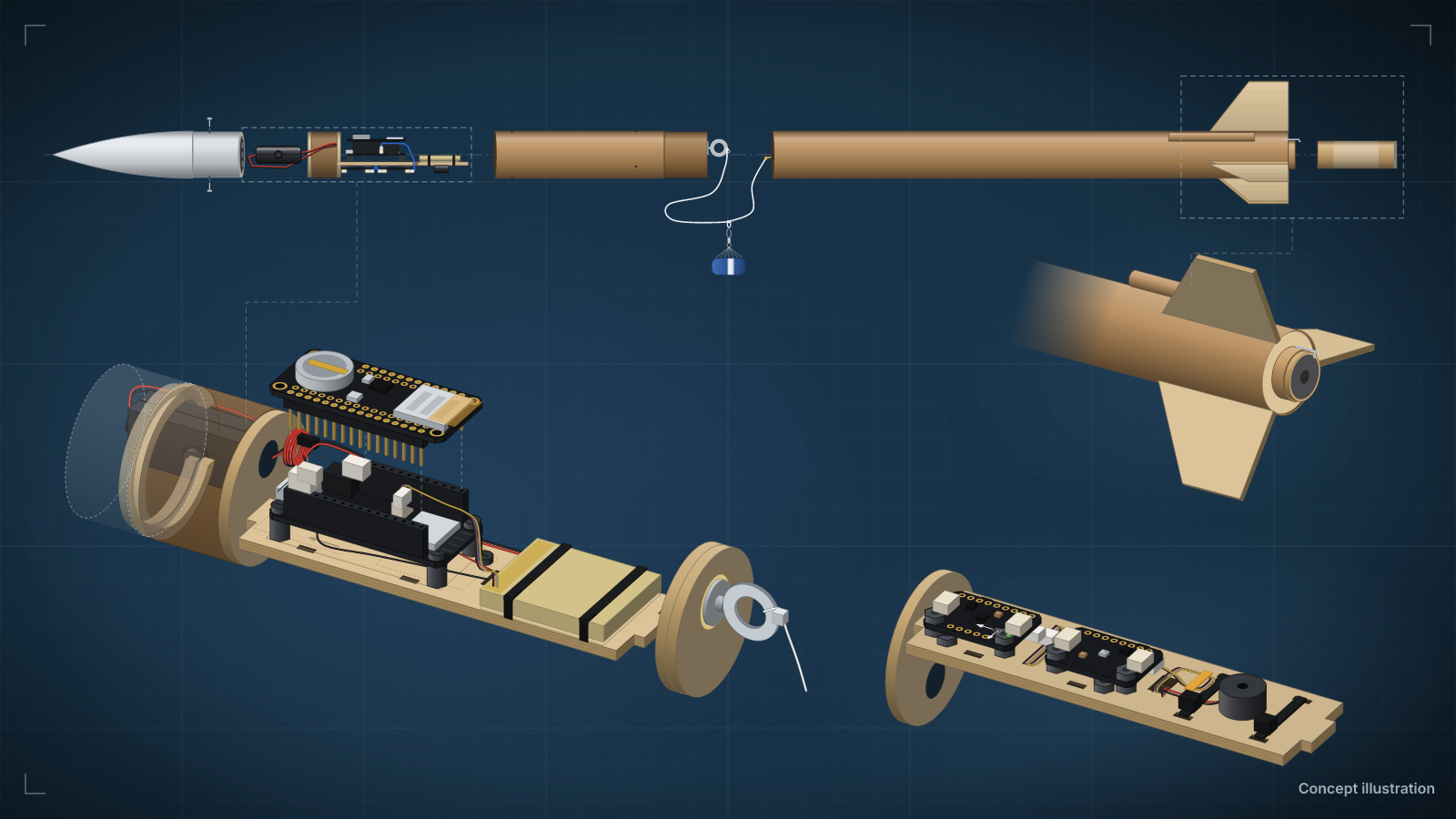
Concept illustration: the avionics sled with ESP32 Feather, barometer, IMU and LiPo, beside a BT-60 model rocket and its recovery harness
Concept illustration of an unbuilt design, drawn from the pack's dimensions. Not a photograph of a finished product.
$17 / $39 / $59 Digital pack

Pricing

Digital guide, cut files, BOM, firmware, labs and teacher materials · Hardware sourced separately (see the BOM below) · Instant download after Stripe checkout · Certified model rocket motors only; an adult range safety officer approves every flight.

Overview & learning outcomes

Students build a barometric + inertial flight computer: an ESP32 Feather, a Bosch BMP390 barometer, an LSM6DSO32 ±32 g IMU, and microSD logging, all on a protected 1S LiPo with a hard arming switch. It rides on a laser-cut 3 mm birch plywood sled in the payload bay of a BT-60 (41.6 mm) airframe with a 24 mm motor mount, flown on certified Estes D12-5 motors. Before each flight, students predict apogee from first principles: the thrust-curve impulse, Newton's second law with varying mass, quadratic drag, and an Euler/RK4 integration. Then they fly, compare the prediction with 50 Hz logged data, explain the error, and iterate the design twice.

The flight computer only records data. It has no pyro channel and fires nothing. The parachute is deployed only by the motor's own ejection charge.

Students will:

  • Convert barometric pressure to altitude with the standard-atmosphere relation and quantify sensor noise and drift on the bench
  • Model a flight with a motor thrust curve, gravity, and quadratic drag (F = ½ρv²C_dA), and integrate it numerically to predict apogee
  • Log, filter, and plot acceleration and altitude; identify boost, burnout, coast, apogee, and descent in real data
  • Compare predicted and measured apogee, back out an effective drag coefficient, and iterate the model over at least two flights
  • Run a launch under the NAR Model Rocket Safety Code with written range procedures

Every high school pack includes worked math and physics, prediction-versus-measurement labs, at least two design-and-test iterations, data logging, a rubric, and documentation templates, plus printable Builder's Corner build journal pages.

System & airframe diagram

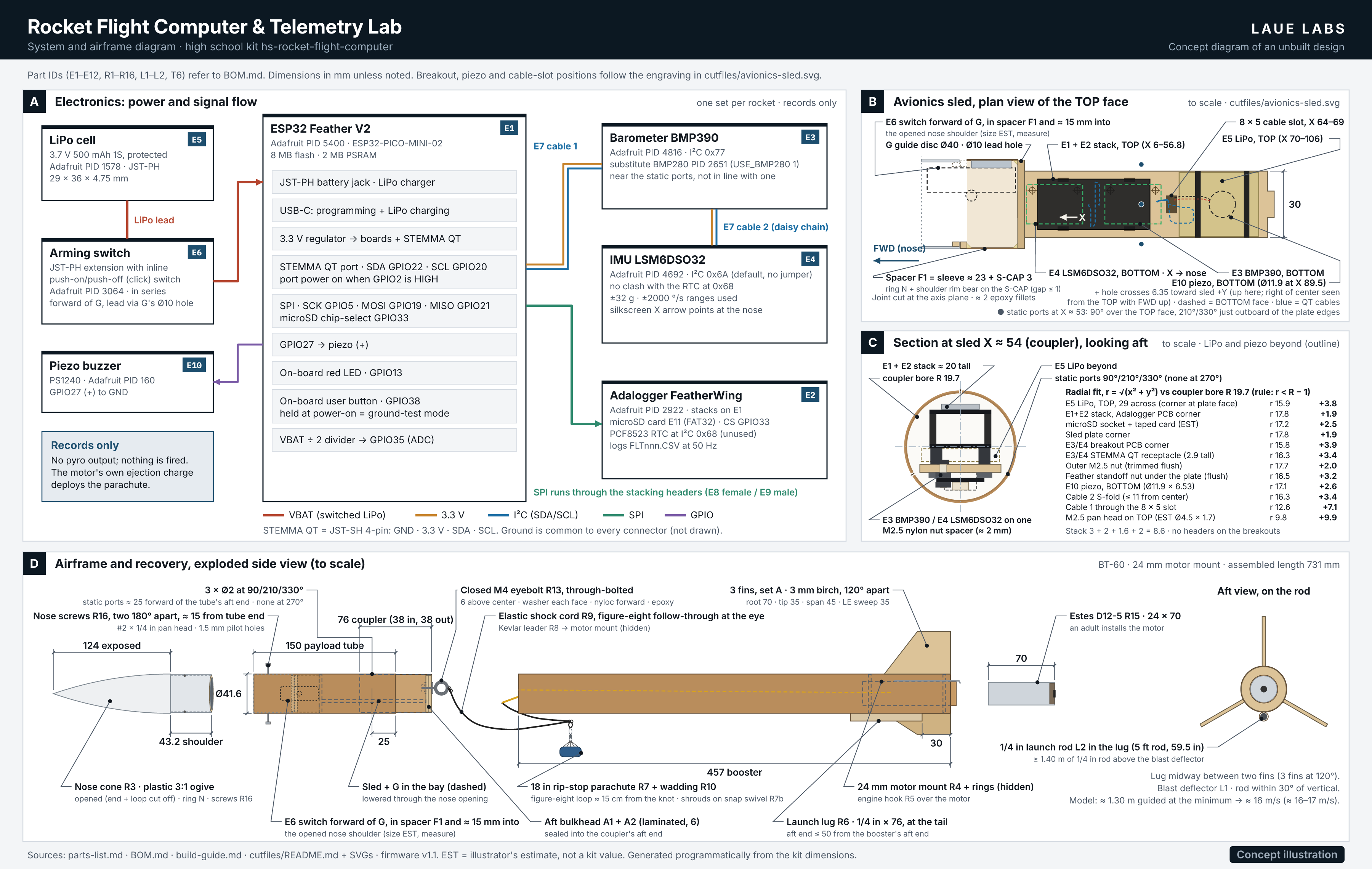
Labeled concept diagram of the rocket flight computer: A, electronics block diagram; B, avionics sled plan view; C, payload-bay section with radial-fit table; D, airframe, recovery and launch rod
Concept illustration. Labeled diagram generated from the pack's dimensions; a concept diagram of an unbuilt design, not a photograph. Open full size for the labels.

Bill of materials & where to buy

Parts, specs, quantities, and estimated unit costs, with places to buy. Prices change; anything marked as an estimate is an estimate. Links were checked when the BOM was written.

Estimated kit cost

  • A. Flight computer electronics (per rocket): $83.50 typical · $73.10 low-cost path
  • B. Rocket / airframe / recovery / motors (per rocket unless noted): $157.03 typical · $145.54 low-cost path
  • C. Launch equipment (once per school/club; reusable): $115.25 typical · $114.25 low-cost path
  • D. Reusable tools and shared supplies: $197.78 typical · $27.90 low-cost path
  • Everything from zero: $553.56 typical · $360.79 low-cost path (low-cost path uses listed substitutes and assumes a school or makerspace already owns reusable tools)

Totals are computed from the line items below. Prices were read from vendor pages on the dates shown and will change. Rows tagged estimate have no verified link and are planning numbers only.

A. Flight computer electronics (per rocket)

IDPart & specQtyUnit (typical)Line (typical)Where to buyCheaper substituteAdult handling / safety gear
E1ESP32 Feather V2 (MCU, LiPo charger, STEMMA QT)
Adafruit PID 5400 · ESP32-PICO-MINI-02, 8 MB flash, 2 MB PSRAM
1$19.95$19.95adafruit.com
Adafruit
$19.95 · checked 2026-10-05 · In stock
Adafruit HUZZAH32 Feather PID 3405 ($19.95, verified): no STEMMA QT, so wire the sensors by hand. Its I2C pins (SDA 23 / SCL 22) come from the board variant, so the bare Wire.begin() needs no edit. GPIO38 is NOT broken out: the firmware moves PIN_BUTTON to GPIO32 with INPUT_PULLUP when compiled for the HUZZAH32 — wire a button from GPIO32 to GND. No VBAT-divider guarantee on the same pin: check the HUZZAH32 pinoutHeader soldering: adult supervision + eye protection; ventilation
E2Adalogger FeatherWing (microSD + RTC)
Adafruit PID 2922 · SD CS = GPIO33 on ESP32 Feathers; RTC PCF8523 @0x68 (unused)
1$8.95$8.95adafruit.com
Adafruit
$8.95 · checked 2026-10-05 · In stock
Any 3.3 V SPI microSD breakout wired to SCK/MOSI/MISO + a free CS pin (edit PIN_SD_CS)Soldering (see E1)
E3Barometer — BMP390 breakout (primary)
Adafruit PID 4816 · Bosch BMP390, I2C 0x77, STEMMA QT; rel. accuracy ±3 Pa (~±0.25 m) per Adafruit
1$10.95$10.95adafruit.com
Adafruit
$10.95 · checked 2026-10-05 · OUT OF STOCK on check date
Adafruit BMP280 PID 2651 ($9.95, verified, in stock): set USE_BMP280 1; rel. accuracy ±12 Pa (~±1 m) per Adafruit. Low total uses this.—
E4IMU — LSM6DSO32 6-DoF breakout (±32 g)
Adafruit PID 4692 · ST LSM6DSO32; ±32 g / ±2000 °/s ranges used (model peak 14–16.7 g → ≥ 1.9× headroom); I2C 0x6A default (no jumper; no clash with RTC 0x68); STEMMA QT
1$12.50$12.50adafruit.com
Adafruit
$12.50 · checked 2026-10-05 · In stock
None recommended. ±16 g parts (e.g., MPU-6050) clip on light builds or on the Estes 20 N·s curve (tech review F5). If you must use one, log the clip flag and bridge clipped spans in analysis—
E5LiPo battery 3.7 V 500 mAh with protection circuit
Adafruit PID 1578 · 1S, JST-PH, 10.5 g, 29×36×4.75 mm; cuts out at 3.0 V; charge ≤500 mA
1$7.95$7.95adafruit.com
Adafruit
$7.95 · checked 2026-10-05 · In stock
Adafruit 1S LiPo 350–1200 mAh with JST-PH (check polarity — other brands can be reversed)LiPo: adult-supervised charging only, never unattended, LiPo-safe bag/metal tin, retire if puffed/damaged; check shipping restrictions
E6Arming switch — JST-PH 2-pin extension with in-line latching push-button
Adafruit PID 3064 · latching push-button: "click once to turn on, click again to turn off" (Adafruit) · ~508 mm, 22 AWG, 10 g; in series with LiPo · housing size not listed by Adafruit (page re-read 2026-10-07; ≈40 × 15 × 11 mm is an estimate from photos): MEASURE it for the fit gate (build guide step 24)
1$2.95$2.95adafruit.com
Adafruit
$2.95 · checked 2026-10-05 · In stock
Only if E6 fails the fit gate: a smaller latching push-button or sub-miniature switch spliced into a JST-PH lead (unverified); re-measure and re-run the rap/drop testArm only at the pad, with RSO permission
E7STEMMA QT / Qwiic cable 100 mm (cable 1)
Adafruit PID 4210 · JST-SH 4-pin both ends · cable 1: Feather (TOP) → down through the sled's 8 × 5 mm centreline slot → BMP390 aft connector (BOTTOM)
1$0.95$0.95adafruit.com
Adafruit
$0.95 · checked 2026-10-05 · In stock
Solder 4 short wires (3V, GND, SDA, SCL)—
E7bSTEMMA QT / Qwiic cable 50 mm (cable 2)
Adafruit PID 4399 · JST-SH 4-pin both ends · cable 2: BMP390 forward connector → LSM6DSO32 aft connector, both on the BOTTOM face; slack in a flat S-fold within ±11 mm of the centreline
1$0.95$0.95adafruit.com
Adafruit
$0.95 · checked 2026-10-05 · In stock
A 100 mm cable (PID 4210) with the extra slack folded flat and taped to the bottom face near the centreline—
E8Feather female header kit (12 + 16 pin)
Adafruit PID 2886 · solder to Feather so the Adalogger plugs on top
1$0.95$0.95adafruit.com
Adafruit
$0.95 · checked 2026-10-05 · In stock
Solder the Adalogger directly to the Feather (not removable)Soldering (see E1)
E9Male header strip (for the Adalogger only; no headers on the BMP390/LSM6DSO32: they connect by STEMMA QT only)
Adafruit PID 392 · 0.1" 36-pin ×10 (shared across class)
1$4.95$4.95adafruit.com
Adafruit
$4.95 (10-pack) · checked 2026-10-05 · In stock
Feather V2 ships with some header (per Adafruit page); low total assumes leftover headerSoldering (see E1)
E10Piezo buzzer PS1240
Adafruit PID 160 · Ø11.90 × 6.53 mm, 0.7 g (Adafruit) · 3–30 Vpp square wave, loudest ~4 kHz; GPIO27→GND · sled BOTTOM face, centred on the engraved circle 89.5 mm aft
1$1.50$1.50adafruit.com
Adafruit
$1.50 · checked 2026-10-05 · In stock
Any small passive piezo—
E11microSD card 512 MB (FAT32)
Adafruit 64MB–512MB micro SD listing (PID 5249 page; 512MB option shown $4.95). One flight ≈ 5 kB/s
1$4.95$4.95adafruit.com
Adafruit
$4.95 (512MB option); $3.50 (64MB) · checked 2026-10-05 · In stock (64MB variant page)
Any 1–32 GB microSD formatted FAT32 (low total: 64 MB at $3.50 is enough for >3 h of logging)—
E12Zip ties, double-sided foam tape, Kapton/masking tape
Small zip ties (≤2.5 mm wide; the LiPo strap uses two, one per aft slot pair, plus cable ties); foam tape to cushion LiPo; tape over SD card
1$6.00 estimate$6.00Any hardware store (no link)
checked 2026-10-05
——
Subtotal$83.50Low-cost path: $73.10

B. Rocket / airframe / recovery / motors (per rocket unless noted)

IDPart & specQtyUnit (typical)Line (typical)Where to buyCheaper substituteAdult handling / safety gear
R1BT-60 body tube 18" (41.6 mm OD, 40.5 mm ID)
Apogee 10141 · 6 per pack, 18 g each · 1 tube = booster, ~150 mm of a 2nd = payload bay (pack covers ~3–4 rockets)
1$17.78$17.78apogeerockets.com
Apogee Components
$17.78 (6-pack) · checked 2026-10-05 · In stock (10+)
Estes BT-60 3-pack $11.29 (verified: https://estesrockets.com/products/bt-60-body-tube). Low total uses this. Apogee 10148 slotted BT-60 2-pack $10.80 (verified on same Apogee page) — check slot length vs fin root before using—
R2BT-60 coupler (payload-bay joint)
Apogee 13019 AC-41.6 · 3/pk, 76 mm long, ID 39.4 mm, OD 40.4 mm
1$4.85$4.85apogeerockets.com
Apogee Components
$4.85 (3-pack) · checked 2026-10-05 · In stock (10+)
Cut 76 mm of BT-60 coupler from another brand; measure ID before cutting bulkheads—
R3Nose cone, plastic 3:1 ogive, BT-60
Apogee 20069 PNC-41.6 · 124 mm exposed, 43.2 mm shoulder (Apogee specs; the same page also lists 1.45 in / 36.8 mm — measure), shoulder OD 40.2 mm, 21.6 g (cone), includes a BT-60→BT-55 transition you can discard · blow-moulded and hollow, but the shoulder's aft end is closed (moulded loop) as supplied: cut it off at Apogee's moulded cut line (build guide step 11)
1$13.15$13.15apogeerockets.com
Apogee Components
$13.15 · checked 2026-10-05 · In stock (10+)
Any BT-60 nose cone; re-measure length and mass for the CP/CG calculation—
R4Motor mount kit 24 mm / BT-60
Apogee 12009 · 24 mm motor tube, cardstock centering rings, engine block; hook NOT included
1$6.93$6.93apogeerockets.com
Apogee Components
$6.93 · checked 2026-10-05 · In stock (10+)
Laser-cut the birch centering rings in cutfiles/ (measure your motor tube OD first) + any 24 mm motor tube—
R5Engine hook, standard 2.75" (24 mm D motors)
Apogee 24048 · 6/pk, spring steel, 69.9 mm
1$6.45$6.45apogeerockets.com
Apogee Components
$6.45 (6-pack) — read via curl; WebFetch timed out · checked 2026-10-05 · In stock (10+)
Screw-on 24 mm motor retainer (unverified)—
R6Launch lug 1/4" (matches 1/4" rod)
Apogee 13057 · 6/pk, 76 mm, ID 7.3 mm
1$3.91$3.91apogeerockets.com
Apogee Components
$3.91 (6-pack) · checked 2026-10-05 · In stock (10+)
3/16" lug only if you also use a 3/16" rod—
R7Parachute 18" rip-stop nylon
Estes Rip Stop Parachute, 18" option · model descent ≈5.1 m/s at ~199 g burnout mass (Cd ≈0.75 assumed); ≈36.5 s from 187 m; the pack drift rule uses wind × 40 s (covers 208 g builds and a flatter chute) · shroud lines tied or larks-headed to a ball-bearing snap swivel (R7b) clipped through a figure-eight loop in the elastic ≈15 cm from the eyebolt (build guide step 7)
1$9.99$9.99estesrockets.com
Estes
$9.99 (18" option in the product JSON; 15" is $6.75 — don't substitute it: ≈6.2 m/s descent) · checked 2026-10-05 · Listed
Apogee 29092 18" printed nylon $7.86 (verified, OUT OF STOCK on check date)—
R7bBall-bearing snap swivel (parachute attachment)
Eagle Claw 01092-003 · ball-bearing swivel with coastlock snap, size 3, 3-pack (one pack covers 3 rockets) · 35 lb test (Eagle Claw product page, size 3 / 01092-003, checked 2026-10-07); the payload-section snatch is ≈11–28 N (≈2.5–6.3 lbf) · clip the snap through the elastic's figure-eight loop and tie or larks-head the shroud lines to the swivel's ring (build guide step 7) · mass not published: weigh it
1$3.49$3.49eagleclaw.com
Eagle Claw
$3.49 (size 3 option, manufacturer page) · checked 2026-10-07 · Listed
Apogee 14509 100-lb ball-bearing swivel $4.84 (1.29 g, welded rings, in stock; verified 2026-10-07: https://www.apogeerockets.com/Building-Supplies/Recovery-Equipment/Swivels/100-lb-Ball-Bearing-Swivel) joined to the loop with an Apogee 29620 1/8" quick link $5.08 (8.5 g, 220 lb, in stock; verified 2026-10-07), or a 1/8" quick link alone—
R8Kevlar shock-cord leader 300 lb
Apogee 30326 · $0.94/ft, 10 ft minimum; use ~2 ft anchored to motor mount
10$0.94$9.40apogeerockets.com
Apogee Components
$0.94/ft (min 10) · checked 2026-10-05 · Listed
Apogee 30325 Kevlar 100 lb $0.80/ft is rated by Apogee for A–C rockets only — not recommended here—
R9Elastic shock cord 1/8"
Apogee 30328 · $0.66/ft, 10 ft min; ~5 ft per rocket
10$0.66$6.60apogeerockets.com
Apogee Components
$0.66/ft (min 10) · checked 2026-10-05 · Listed
Estes shock cord & mount pack (seen as SOLD OUT on Estes page)—
R10Recovery wadding
Estes · ~72 sheets (~18–25 launches per Estes)
1$5.99$5.99estesrockets.com
Estes
$5.99 · checked 2026-10-05 · Listed
Reusable Nomex chute protector (unverified)Only flame-resistant wadding (NAR code)
R11Birch plywood 3 mm (1/8") 12×24"
Midwest Products 5244 aircraft birch · one sheet ≈ parts for several rockets
1$24.01$24.01hobbylinc.com
Hobbylinc
$24.01 ("Email When Available" = not in stock on check date) · checked 2026-10-05 · Not available on check date
Any laser-grade 3 mm birch ply from a makerspace or craft store; cardboard is NOT acceptable for finsLaser cutting: trained adult operator, never unattended
R12Wood glue (aliphatic, e.g. Titebond II) 8 oz
For fins, rings, bulkheads, lug; CA or epoxy optional
1$6.00 estimate$6.00Home Depot / Lowe's / hardware store (no link)
checked 2026-10-05
Any yellow wood glue—
R13Closed eyebolt + 2 flat washers (12 mm OD) + nyloc nut (shock-cord anchor)
M4 (or #8-32) forged or welded CLOSED eyebolt, ~20–25 mm shank, through the 6 mm laminated bulkhead; washer each face: M4 DIN 9021 (12 mm OD) or #8 SAE flat — NOT a ¾–1 in fender washer, which would overlap A2's sled slot; nyloc on the forward face; epoxy seal. NOT a wood-screw eye
1$3.00 estimate$3.00Hardware store (no link)
checked 2026-10-05
Commercial BT-60 coupler bulkhead with an installed eyebolt (unverified; Apogee page timed out)—
R14Ballast for Iteration 1 (≈25 g)
Modeling clay or epoxy putty, secured to forward sled bulkhead
1$2.00 estimate$2.00Any (no link)
checked 2026-10-05
Clay or epoxy putty only (keeps the FAA 101.22(a) "no substantial metal parts" criterion obviously met)—
R15Motors — Estes D12-5 (2-pack, incl. 2 starters + 4 plugs)
NAR-certified 24×70 mm black powder; Estes: 20.00 N·s (label), max liftoff 283 g. thrustcurve.org/NAR cert data: 16.84 N·s, 10.21 N avg, 1.65 s burn
2$15.99$31.98estesrockets.com
Estes
$15.99 (2-pack) · checked 2026-10-05 · Listed (physical address required)
Estes D12-3 2-pack $15.99 (verified: https://estesrockets.com/products/d12-3-engines) — only if your liftoff mass is above the D12-5's 283 g limit and your sim's coast time is closer to 3 s (Estes D12-3 upper mass limit not verified)Adult (18+) buys, stores (cool, dry, away from ignition sources) and installs. No federal minimum age for ≤ D motors (CPSC exempt, 16 CFR 1500.85(a)(8), per the NAR Laws and Regulations page); check your state (e.g., CA: 14+ for ≤ D, 12+ in an adult-run education program; CSFM-approved motors only — verify the current 19 CCR §1027 text) and your district. Never modify. 4 motors = baseline + 2 iterations + 1 spare
R16Nose-retention screws, #2 × 1/4" pan head (2 per flight set)
Through the payload tube into the plastic nose shoulder (1.5 mm pilot holes); removable for access. Required for EVERY flight (tech review F1)
1$1.50 estimate$1.50Hardware store (no link)
checked 2026-10-05
Nylon push rivets of similar size, or masking tape around the joint + a ≥10 N tug test—
Subtotal$157.03Low-cost path: $145.54

C. Launch equipment (once per school/club; reusable)

IDPart & specQtyUnit (typical)Line (typical)Where to buyCheaper substituteAdult handling / safety gear
L1Launch pad, E-rated, with 1/4" rod and blast deflector
Estes Porta-Pad E
1$35.99$35.99estesrockets.com
Estes
$35.99 · checked 2026-10-05 · Listed
Club/school pad that accepts a 1/4" rod and has a blast deflectorAdult/RSO sets up; rod tip capped when not in use (NAR code)
L21/4" two-piece launch rod (nominal 5 ft; 59.5 in = 1.51 m)
Estes · 59.5 in (1.51 m) per eRockets listing · compatible with Porta-Pad E · pack rule: ≥ 1.40 m of rod ABOVE the blast deflector (≈1.30 m guided with a tail lug → model rod exit ≈16.0 m/s at 220 g, 15.9 m/s at 223 g); ≈15 m/s with a mid-body lug on the full rod, ≈9 m/s on a 3 ft rod
1$16.99$16.99estesrockets.com
Estes
$16.99 · checked 2026-10-05 · Listed
A 1/4" rod you already own or the club provides, if ≥ 1.40 m of it stands above the blast deflector. The rod included with the pad is NOT counted because its length isn't stated on the Estes page; measure itEye-level rod tip hazard — cap it
L3Launch controller with safety key, continuity light, 30 ft cable
Estes E Launch Controller · needs 4× AA
1$35.99$35.99estesrockets.com
Estes
$35.99 · checked 2026-10-05 · Listed
Estes Electron Beam controller (17 ft cable per search result; page not fetched — unverified)ADULT/RSO holds the safety key. One igniter rule: igniter installed at the pad, rocket on the rod, safety key out; clips not attached until the avionics are armed
L4AA alkaline batteries (4) for controller
Fresh cells — weak cells cause misfires with modern starters
1$5.00 estimate$5.00Any (no link)
checked 2026-10-05
——
L5Safety glasses, ANSI Z87.1 Z87+ (high-impact) (one per team member)
3M SecureFit SF201AF · clear anti-fog polycarbonate lens marked Z87+ (ANSI Z87.1 impact-rated; 3M spec table on strobelssupply.com and safetycompany.com, read 2026-10-09)
4$5.32$21.28platt.com
Platt Electric Supply
$5.32 EA · checked 2026-10-09 · 40 in stock (company-wide)
Any glasses marked Z87+ (ANSI Z87.1 high-impact). Not SparkFun SWG-11046: it lists only CE/EN 1836, a sunglass standard, not impact-ratedRequired for soldering, cutting, sanding, motor prep and launch
L6Fire safety at pad (bucket of water / extinguisher)
School-owned; required by most clubs/RSOs
1$0.00 estimate$0.00School (no link)
checked 2026-10-05
—Adult
Subtotal$115.25Low-cost path: $114.25

D. Reusable tools and shared supplies

IDPart & specQtyUnit (typical)Line (typical)Where to buyCheaper substituteAdult handling / safety gear
T1Temperature-controlled soldering iron
PINECIL (B2 tip; USB-C PD power adapter, stand and sponge NOT included per SparkFun)
1$68.50$68.50sparkfun.com
SparkFun
$68.50 · checked 2026-10-05 · In stock
Any temperature-controlled station already in the lab (low total assumes school owns one)Adult supervision, eye protection, ventilation, heat-safe stand
T2Lead-free solder 15 g
SparkFun · 0.031", SAC305 no-clean
1$4.95$4.95sparkfun.com
SparkFun
$4.95 · checked 2026-10-05 · In stock
Any 0.6–0.8 mm rosin-core solderWash hands after soldering
T3Digital multimeter
SparkFun Digital Multimeter – Basic (DC V, continuity, 200 mA/10 A ranges)
1$21.50$21.50sparkfun.com
SparkFun
$21.50 · checked 2026-10-05 · In stock
Any DMM already owned—
T4Digital calipers 150 mm
SparkFun · 0.01 mm resolution, ±0.02 mm <100 mm
1$19.95$19.95sparkfun.com
SparkFun
$19.95 · checked 2026-10-05 · In stock (only 1 left on check date)
Steel rule (less precise) / any calipers owned—
T5Digital scale 0.1 g, ≥500 g capacity
Smart Weigh ZIP600 (600 g × 0.1 g)
1$33.98$33.98newegg.com
Newegg (third-party seller)
$33.98 · checked 2026-10-05 · Listed
Any 0.1 g / 500 g+ scale (chemistry lab). Mass is the #1 apogee driver — don't skip weighing—
T6M2.5 nylon screw + standoff set (incl. 80 M2.5 nuts)
Adafruit PID 3299 · 380 pcs (one set ≈ 6 rockets; add M2.5 nylon nuts for larger classes): 80 M2.5 hex nuts, 80 × 4 mm, 80 × 6 mm, 40 × 10 mm screws, F-F and M-F standoffs 6–12 mm (Adafruit). Feather: on the standoffs. BMP390 / LSM6DSO32: NOT on standoffs — 2 × M2.5 × 10 mm screws each, head on the sled TOP face, one M2.5 nut (≈2 mm) as the spacer under the board and one nut outside, tip trimmed flush (8 nuts total; build guide step 23)
1$16.95$16.95adafruit.com
Adafruit
$16.95 · checked 2026-10-05 · In stock
Any M2.5 nylon hardware—
T7USB-A to USB-C cable (data)
Adafruit PID 4474 · ~1 m (Feather V2 is USB-C)
1$4.95$4.95adafruit.com
Adafruit
$4.95 (read via curl) · checked 2026-10-05 · Listed
Any USB-C data cable (not charge-only)—
T8Hobby knife, sandpaper (220/400), masking tape, pencil
Basic build consumables
1$12.00 estimate$12.00Any (no link)
checked 2026-10-05
—Hobby knife: cut away from body, adult supervision
T9Laser cutter access or cutting service
Makerspace time or mail-order cut of the SVGs (3 mm birch)
1$15.00 estimate$15.00Makerspace / cut service (no link)
checked 2026-10-05
Scroll saw / coping saw from printed templates (slower, less accurate)Trained adult operator
Subtotal$197.78Low-cost path: $27.90

The pack is digital files only. Hardware is bought separately.

Standards map

These are standards the pack's activities are mapped to by Laue Labs. They are not a certification or endorsement by any standards body or state.

The activities below are mapped to these standards by Laue Labs. This is an alignment aid for teachers. It isn't an official certification or endorsement by NGSS, Achieve, NGA/CCSSO, or any state. Check against your state's adopted standards.

Next Generation Science Standards (NGSS), high school

Performance expectation Where it shows up
HS-PS2-1: analyze data to support the claim that Newton's second law describes the relationship among net force, mass, and acceleration Lab 4: accelerometer data vs. the model's (T − mg − D)/m; Lab 5: mass iteration
HS-PS2-2: use mathematical representations to support the claim that total momentum is conserved when there's no net external force first-principles §2: variable-mass derivation, rocket equation, why F = d(mv)/dt for the rocket alone is wrong
HS-PS2-3: apply scientific and engineering ideas to design, evaluate, and refine a device that minimizes the force on a macroscopic object during a collision Recovery: parachute sizing and descent rate (§9); landing speed vs. damage
HS-PS3-1: create a computational model to calculate the change in the energy of one component in a system when the change in energy of the other component(s) and energy flows in and out of the system are known Extension: energy bookkeeping from the model trajectory (kinetic, potential, work done by drag)
HS-ETS1-1: analyze a major global challenge to specify qualitative and quantitative criteria and constraints for solutions Partial: the design criteria and constraints (≥1 cal margin, ±32 g IMU range vs. a 14–17 g model peak, 5 ft rod / rod-exit speed, 10 mph wind and drift distance, delay matching, mass limit 283 g). The "global challenge" framing is for the teacher to add (e.g., low-cost atmospheric sensing)
HS-ETS1-2: design a solution to a complex real-world problem by breaking it down into smaller, more manageable problems Subsystems: power, sensing, logging, firmware states, airframe, recovery
HS-ETS1-3: evaluate a solution based on prioritized criteria and trade-offs Lab 5: fin set B stability vs. drag/mass; ballast vs. apogee
HS-ETS1-4: use a computer simulation to model the impact of proposed solutions Lab 3/5: Euler/RK4 simulation predicts each iteration before it flies

Science and engineering practices: developing and using models; planning and carrying out investigations; analyzing and interpreting data; using mathematics and computational thinking; constructing explanations and designing solutions.

Common Core State Standards, Mathematics (high school)

Standard Where
N-Q.A.1–3: units, quantities, appropriate accuracy Unit checks throughout; reporting precision vs. sensor accuracy
A-CED.A.4: rearrange formulas to highlight a quantity of interest Solving the barometric formula for z; descent-rate and coast formulas
F-IF.B.6: average rate of change Velocity from altitude data; descent rate
F-LE.A.4: solve exponential equations with logarithms Barometric formula; rocket equation
S-ID.A.4: use mean and standard deviation Sensor noise characterization (Lab 2)
S-ID.B.6: fit a function to data Descent-rate fit; altitude vs. time
Modeling (★) The whole predict–test–revise cycle

Common Core ELA, Literacy in Science and Technical Subjects (grades 11–12)

Standard Where
RST.11-12.3: follow a complex multistep procedure Build guide, pre-flight checklist
RST.11-12.7: integrate information from diverse formats Combining datasheets, thrust curves, plots, and tables
WHST.11-12.1: write arguments focused on discipline-specific content Flight report: claim–evidence–reasoning

License options & buy

Predicted values come from models, datasheets and manufacturer data, with sources cited. See safety & legal notes.

$17 Individual

One student or one household.

You may:

  • Use, print, and modify the files for your own builds and experiments
  • Share photos and videos of your finished project

You may not:

  • Use the pack as curriculum for a class, club, camp, or co-op (see Homeschool / Co-op and Classroom)
  • Redistribute, resell, or publish the pack files
$39 Homeschool / Co-op

One homeschool family, or one co-op group of up to 10 learners with its facilitator(s).

You may:

  • Print guides and lab sheets for the learners in that family or co-op group
  • Use the facilitator notes, rubric, and pacing guide with that group

You may not:

  • Use it for a co-op group larger than 10 learners, or for a school class (see Classroom)
  • Redistribute, resell, or publish the pack files
$59 Classroom

1 teacher, up to 30 students, in a single class or cohort.

You may:

  • Print or project materials for those students
  • Copy code and cut files to student machines for that class

You may not:

  • Share files with other teachers or schools, or post them publicly
  • Use it as a whole-school or multi-year site license, or for more than 30 students, without contacting us

Build materials available at cost + 10% — email for a quote

All licenses: digital files only (hardware not included). Keep Laue Labs attribution on printed handouts. After checkout you get an instant download on the thanks page. License questions, more learners, or site licenses: lance.haney@gmail.com.

Safety & legal notes

  • Certified, commercially made model rocket motors only, used per the NAR Model Rocket Safety Code and NFPA 1122. No homemade motors or propellant.
  • An adult (18+) buys, stores, and installs motors and igniters. State and school-district rules on motor purchase and launches vary; check yours first.
  • The flight computer is a passive data logger. It is never wired to ignite motors, ejection charges, or any pyrotechnic. The parachute is deployed only by the motor's own ejection charge.
  • An adult range safety officer holds the launch-controller safety key and approves every flight. The igniter goes in only at the pad, with the safety key out.
  • Launch limits used in this pack: a 1/4 in launch rod with at least 1.40 m above the blast deflector (the 5 ft rod in the BOM) and a tail-mounted launch lug, wind ≤ 10 mph, and clear ground downwind of about wind speed × 40 s of descent, with no power lines, roads, or tall trees in that zone.
  • This rocket is a Class 1 model rocket under FAA 14 CFR 101.22 (≤ 1,500 g including propellant, ≤ 125 g propellant). No FAA waiver or notification is needed, but the flight must create no hazard to people, property, or aircraft (§101.23). The NAR code adds: never launch into clouds or near aircraft.
  • Protected LiPo cells only. Charging needs adult supervision on a non-flammable surface, never unattended; store and carry the cell in a LiPo bag.
  • Soldering and laser cutting: adult supervision (a trained adult runs the laser), ventilation, and eye protection.
  • Predicted values in this pack come from models, datasheets, and manufacturer data, with sources cited.
  • Students should work with adult supervision for tools, soldering, batteries, and anything flagged in the BOM.