
Projects / IR Tripwire Doorbell
IR Tripwire Doorbell
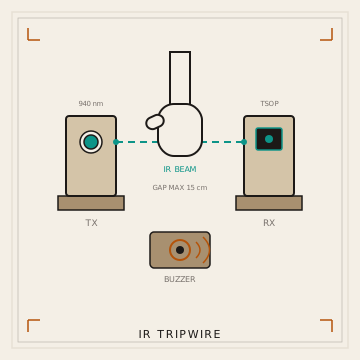
Build a beam-break doorbell: an IR LED and phototransistor face each other on laser-cut 3mm birch plywood mounts. Start with the bench version (DC beam, gap ≤ 15 cm), then upgrade to the doorway version: 38 kHz IR bursts and a TSOP38238 receiver for a beam over 3 m that ignores room light. When something breaks the beam, the Arduino fires a buzzer.
Digital guide + cut files + BOM + code · Parts sourced separately · Ages 8–14 with adult help
Pack contents
- Build guide: cut, mount, wire, threshold, tune
- SVG cut files for emitter & detector brackets
- First-principles: IR, beam-break, noise, Schmitt/threshold
- Full Arduino sketch: hysteresis (bench) and 38 kHz burst mode (doorway)
- Verified BOM (~$16–80 hardware)
Typical hardware cost
Default structure is laser-cut birch plywood with real fasteners and hobby electronics you can source—honest BOM, not mystery modules.
- ~$16–80 in typical parts (makerspace cut toward the low end; mail-order toward the high end)
- Digital pack price ≠ hardware
The $7 pack is the digital guide + cut files + BOM + lessons + code, plus printable Builder's Corner build journal pages. Hardware is sourced separately — see Where to get kit materials. Buy with Stripe is live below.
Questions? Email us at lance.haney@gmail.com.
Pricing
- Home / Personal license $7
- Classroom license $29 — 1 teacher, up to 30 studentsOne $29 Classroom license covers one group of up to 30 students. Each additional group needs another license.
- Build materials available at cost + 10% — email for a quote
Learning outcomes
- Explain optical path and beam-break voltage change
- Wire IR emitter and phototransistor to an analog input
- Choose a detection threshold from measured readings
- Apply hysteresis to avoid chatter