
Shop / Track a Falling Satellite
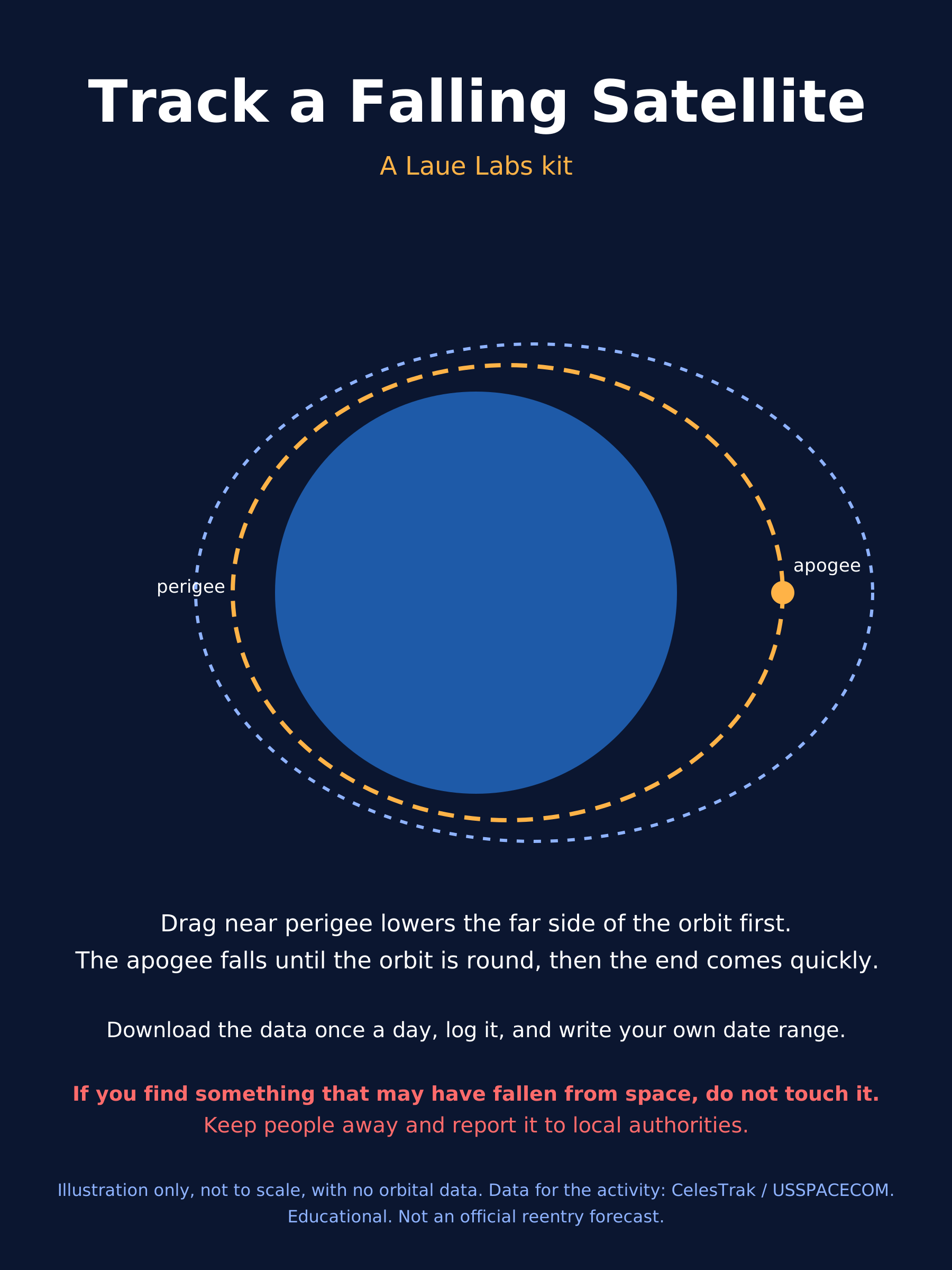
Track a Falling Satellite
Old satellites and spent rocket stages slowly drop out of orbit as the thin upper air drags on them. In this Laue Labs pack, readers follow one real object, the ZHUQUE-2E upper stage (catalog number 69095), from public data they download themselves. On 29 October 2026 its orbit ran from about 186 km to about 485 km, and it was losing about 2 km of mean altitude a day, so it is expected to reenter within weeks. Your job is to estimate when. They log its orbit each day, plot how its apogee falls toward its perigee, and write their own date range for its reentry.
Digital pack: explainer, laptop activity, worksheet with answer key, tests and a poster · Needs a laptop with Python
Pack contents
- Explainer: why drag lowers an orbit, how to read a two-line element set, why the satellite speeds up as it falls, and why reentry dates come as ranges
- Worked example from a past reentry: a CZ-7 upper stage that came down on 29 July 2025
- Laptop activity with a command-line program and a Jupyter notebook, including ISS pass predictions for the reader's location
- Worksheet and answer key
- Tests that show the program works
- A printable poster and a safety note
What this pack is not
Laue Labs made this pack for learning. It is not an official reentry forecast, and nothing in it can say exactly when or where an object will land. The pack ships no live orbital data; readers download their own from CelesTrak, a free public service, and the program limits itself to one download of the same data every two hours, as CelesTrak asks.
Readers finish by writing a sentence like this one: “Based on my data, I expect it to come down between date A and date B, and I could still be wrong. I can't say exactly when or where it will land.”
Printed booklet
Coming soon: the same content as the digital pack, printed as a booklet with the full program listing and the poster. Ships to US addresses. Made to order.
Safety: the activity happens entirely on a screen. If you ever find something you think fell from space, do not touch or move it. Keep people away and report it to local authorities.
Orbital data courtesy of CelesTrak / USSPACECOM. Questions? Email us at lance.haney@gmail.com.
Learning outcomes
- Compute altitude, perigee and apogee from an element set using Kepler's third law
- Explain why a satellite losing energy to drag ends up moving faster
- Keep a daily log of real orbital data and plot it
- Describe a reentry estimate as a date range with honest uncertainty